
We integrated Lodgify with Airbnb and Vrbo for an Australian holiday-rental company
We performed a software integration from Lodgify to Airbnb and Vrbo for a luxury Australian holiday-rental business to allow automatic updates to rate changes, availability, and content.
Elite Accommodation, the business we performed the integration for, manages a range of luxury holiday rentals in the most sought-after locations in Adelaide. They reached out because the manual double handling of the information across Lodgify, Airbnb, and Vrbo consumed a significant amount of time and resources. The manual syncing of data led to clerical errors between the platforms and constant calendar availability conflicts which caused booking cancellations.
Every rate change, availability block, and description edit had to be repeated across all 3 platforms. A complete pain in the ass that required constant double handling of information across Lodgify, Airbnb, and Vrbo.
I had previously worked with booking and property platforms but not for a software integration specific to Lodgify, Airbnb, and Vrbo. I quickly found out why many businesses leave this software integration half finished.
Why Lodgify, Airbnb, and Vrbo
Lodgify is a property management system and channel manager. It holds the master copy of each property including rates, availability, photos, descriptions, and other general info. It also provides a direct booking website and payments to allow direct bookings without 3rd party marketplaces.
Airbnb and Vrbo are the 3rd party marketplaces where travellers search and book holiday-rentals. Lodgify is technically meant to sit in the middle and keep everything in sync, which enables a business to manage one system instead of three.
That is the promise… but in reality each marketplace has its own rules, commission rates, and data model on how they list properties on their marketplaces. As you can imagine, this makes integrating between the different platforms a pain in the ass (as I will explain next).
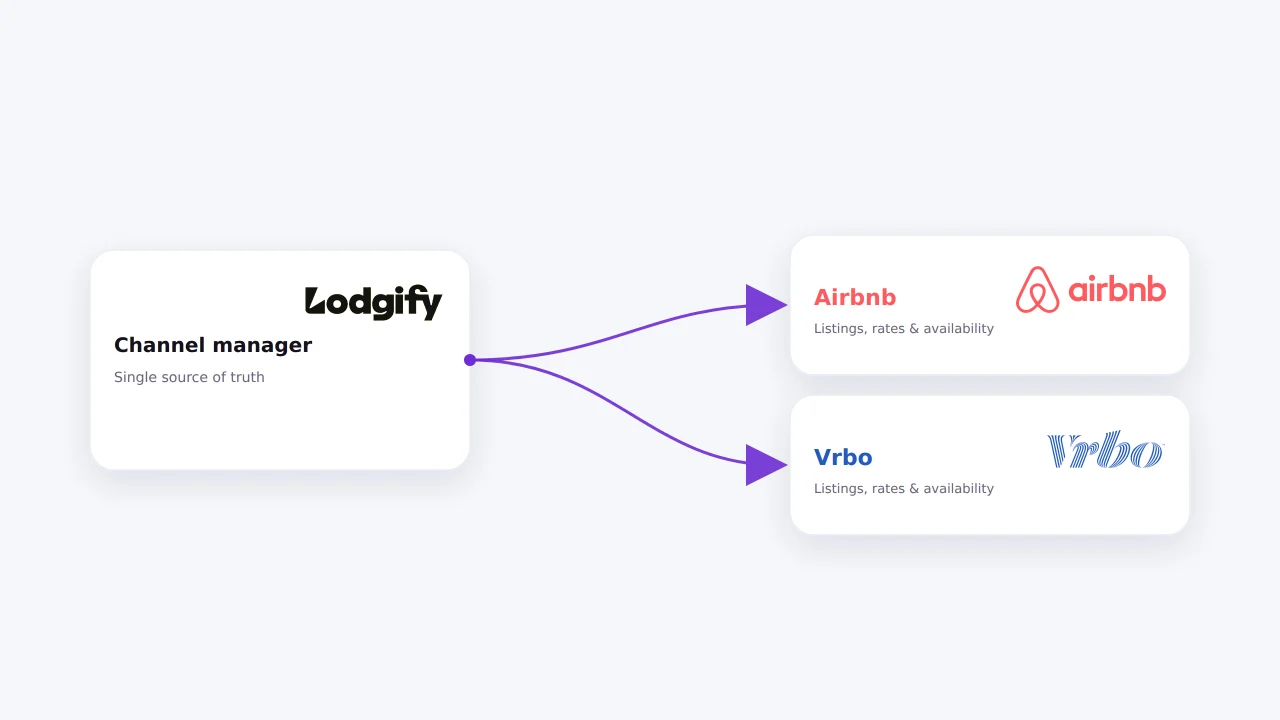 One system to manage, three marketplaces to keep in sync.
The Pains of Syncing Lodgify with Airbnb and Vrbo
As with all integrations in my software career thus far, integrating between multiple platforms is unfortunately not a “one-click” process. We ran into a bunch of subtle issues with setting up the integrations that required manual intervention.
Pain 1: my client required higher rental rates to account for the commission fees of Airbnb and Vrbo. This meant I was forced to algebraically calculate the right markup fee for both platforms. The maths required me to perform the correct rounding to avoid the situation where my client might receive a shortfall due to unique commission fee differences.
Pain 2: both Airbnb and Vrbo enforce different content rules. For example, Vrbo wanted titles between 20 and 80 characters, descriptions between 400 and 10,000 characters, and at least six photos covering specific rooms. However, Airbnb capped descriptions at 500 characters. That left a narrow 400-to-500-character window to satisfy both. This forced my client to painstakingly review every property description to ensure it sat between 400 and 500 characters.
Pain 3: my client stylistically used all capital letters for the titles of their properties, nothing nefarious at all. Airbnb then surprised us when they refused to sync the properties because they enforced a content rule of no capital letters in titles. They explained that others used all capitals in titles to capture attention and they therefore banned it.
Pain 4: Vrbo onboarding is almost all manual compared to Airbnb. I went back and forth with the integration team from Expedia Group (the owners of Vrbo) which required a property-mapping spreadsheet. Then they audited the spreadsheet for correctness (but provided unclear error messages). I went through several failed audits, for example, one audit failed because of an error called “Unit not found” as seen in the example screenshot below:
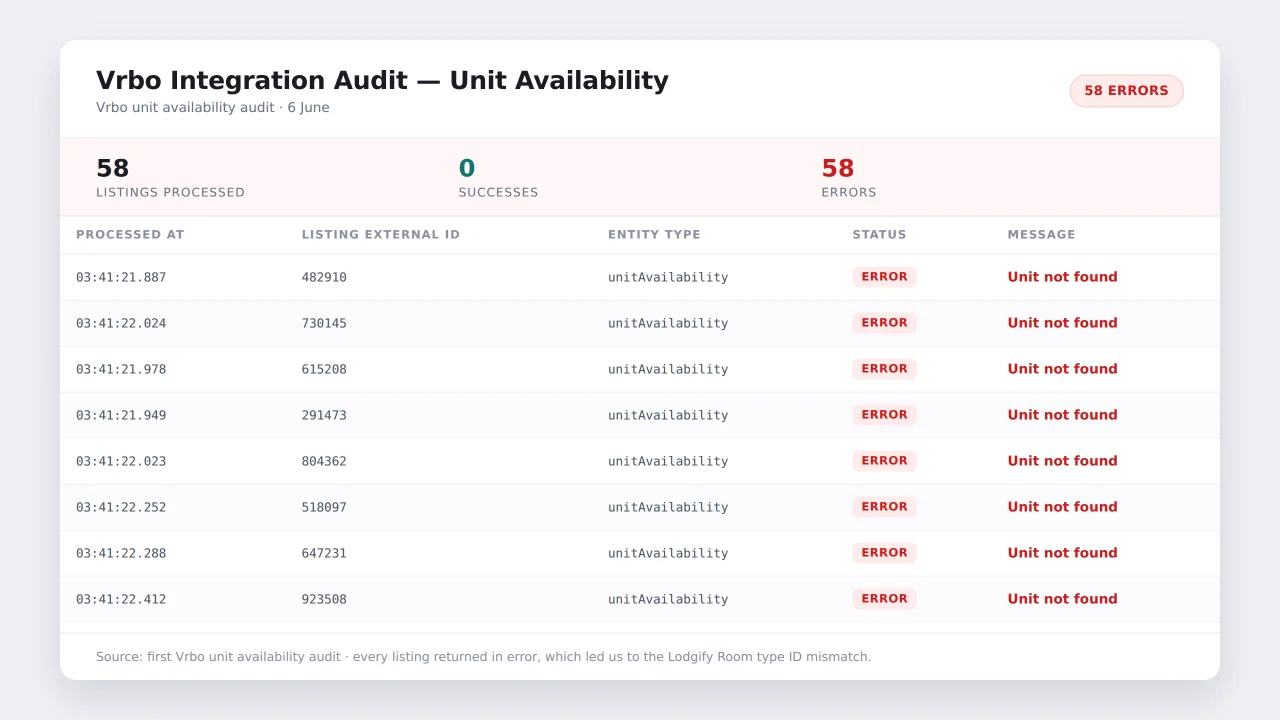 58 listings and 58 errors… let’s just say the first Vrbo audit wasn’t very successful!
Later audits threw up missing rates, missing sleeps, duplicate images, and listings that would not go live until a “listing product type” was chosen. This back and forth took a significant amount of time to get right. I hope they improve the experience in the future.
The rest of the pains: I discovered a whole heap of other minor issues along the way such as:
- Airbnb duplicated booking, linen, and management fees
- Surcharges failed to carry across on short stays
- Lodgify kept reverting the Airbnb booking window from 270 days back to 180
… I could write a whole blog post on the other pains we faced but I will stop here.
The Integration Process
When I perform an integration I always kick off with one platform at a time. My starting point was Airbnb. I connected it through Lodgify and worked through each property at a time:
- Added the business’s tax information
- Configured the markup
- Added the payment processing fee
- Ran test bookings until the numbers lined up
Note: test bookings are not free because the processing fees are non-refundable. Therefore, I performed a test sparingly to not blow my client’s budget.
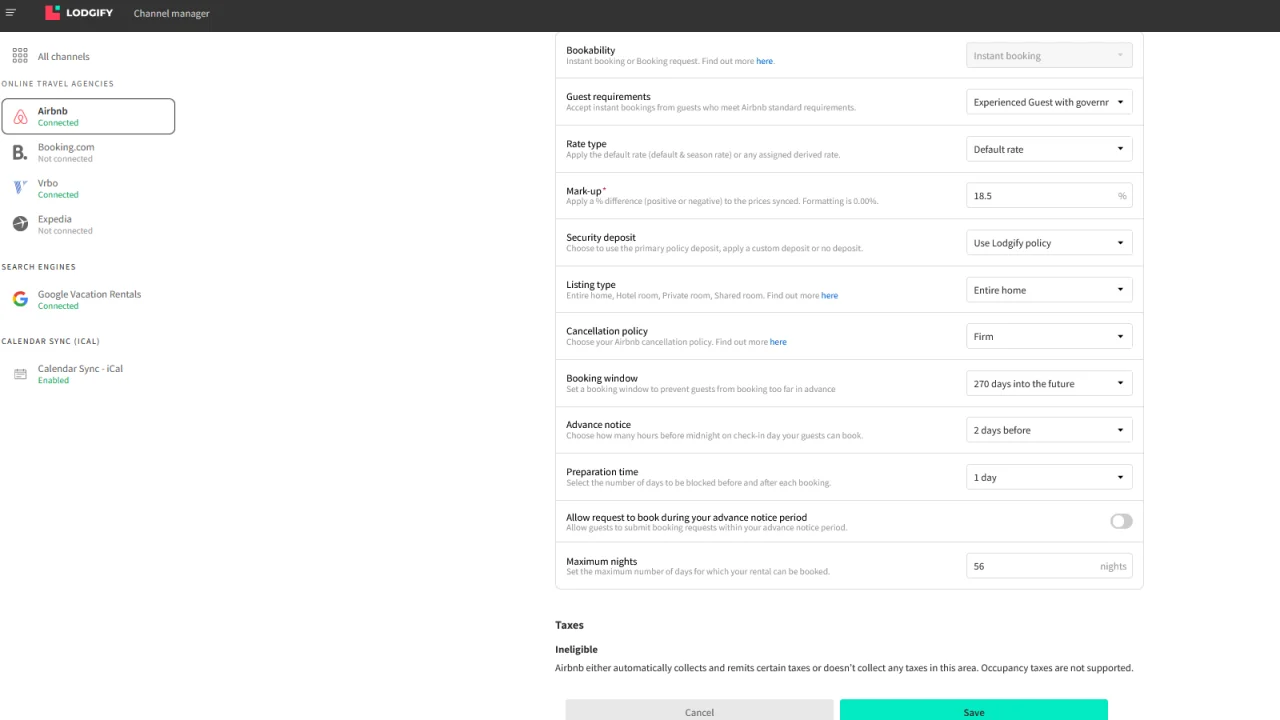 Airbnb, Vrbo, and Google Vacation Rentals all connected inside Lodgify, with the Airbnb mark-up configured.
When I finished with Airbnb I transitioned to Vrbo. Let’s just say it took almost twice as long due to the manual processing I mentioned earlier. After Lodgify raised the connection I was forced to coordinate with the Expedia onboarding team on property-mapping. Although the Vrbo integration took longer it turned out better for my client because they maintained their previous listing. Airbnb wasn’t that kind and we therefore lost the previous listing.
Finally, I reconciled what could not be integrated automatically (which was most things). As I mentioned in the previous section, both Airbnb and Vrbo differed in many ways. This directly affected the way in which we presented the information within Lodgify. After much back and forth we eventually achieved the result. A few hiccups happened after the software integration completed but after several months my client used the integration without any further maintenance. We got there in the end!
Software Integrations Aren’t Easy… Ever
As Software Engineer contractors we work with a wide range of unique software products which present their own unique set of challenges. The Lodgify software integration between Airbnb and Vrbo proved difficult not because of the software but due to the underlying differences in their data model. Although software integrations require expert assistance, my client more than offset the short term cost of our consultation fees with the long term savings of not having to double-handle information and avoiding costly mistakes from clerical errors.
If you run a holiday rental in Adelaide or around Australia and you require a software integration with Lodgify then feel free to reach out to us to consult.